The emphasis in the design of a contemporary solar power system is frequently skewed towards energy production—efficiency of panels and conversion rates of inverters. Nevertheless, the economic and operational sustainability of any solar installation is based on its protection measures. The circuit breaker for solar system safety is the core of this safety architecture, providing peace of mind to system owners.
A solar setup is not just a generator, it is a live, high-voltage direct current (DC) power plant that is mounted on residential roofs or industrial fields. The protective requirements increase with the capacity of the system. The necessity of a strong protection is everywhere, whether it is the protection of the circuits in a PV combiner box where the power is concentrated, or the control of the multiple outputs in DC load panels where homeowners use direct current directly.
The dangers of this DC transmission, namely sustained arcing and electrical hazards, are not the same as those of normal AC grids. Thus, the choice of circuit protection – of each solution, whether combiner boxes or main distribution – is not a frivolous accessory choice; it is an important engineering calculation.
This guide is a strict examination of the types of solar circuit breakers, their particular use in the photovoltaic system topology, and the mathematical model needed to size them appropriately.
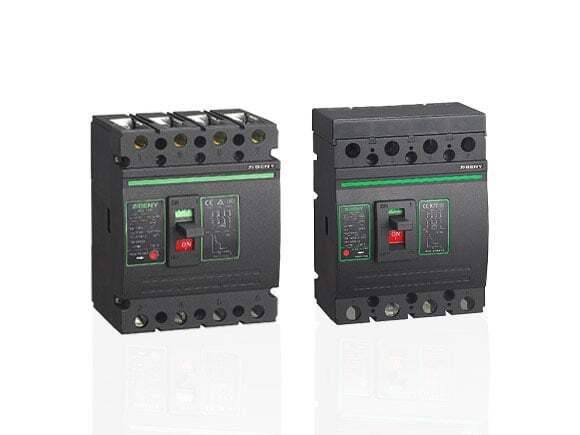
A solar system circuit breaker is an automatic protection device that is used to protect electrical circuits against damage due to overload or short circuit caused by excess current. A circuit breaker is a durable switching device unlike a simple fuse which only works once and has to be replaced. It may be rebooted (manually or automatically) to continue normal operation following the mitigation of an error.
A DC circuit breaker has two main purposes in the particular case of Photovoltaics (PV):
There is a need to differentiate between a DC Isolator and a DC Circuit Breaker. Although an isolator can be used to interrupt the circuit to maintain it, it does not necessarily provide automatic overcurrent protection. A circuit breaker offers the required isolation as mentioned above and active fault protection.
The replacement of Alternating Current (AC) breakers with Direct Current (DC) is one of the most widespread and hazardous mistakes in solar installation. The devices appear similar to the untrained eye. They exist in radically different realities to a physicist or electrical engineer.
The most important difference is the phenomenon of Zero-Crossing.
When a typical AC breaker is employed in a solar DC circuit, it might not be able to interrupt the arc on tripping. This causes contact welding, in which the breaker fuses close and fail to open the power or it causes the total destruction of the breaker housing, which frequently causes an electrical fire.
Thus, the Solar DC Circuit Breakers are designed with sophisticated arc-extinguishing chambers. These use magnetic blowout coils to physically stretch the arc and push it into “arc chutes” where it is divided and cooled quickly. It is a mandatory safety measure to use a dedicated DC breaker rather than relying on an ac input circuit breaker panel for DC loads.
The solar protection is directly proportional to the energy density. The market has circuit breakers as small as agile 15-amp to use in residential wiring, and as large as 6000-amp switchgear to use in utility-scale infrastructure.
Although functionally, the most common types of circuit breakers may be divided into Standard, GFCI (Ground Fault), and AFCI (Arc Fault) types, each with a specific protection role to perform, engineers determine the main choice depending on the size of the system and the physical design of the device. The hardware hierarchy is divided into three broad structural categories:
| Breaker Type | Typical Current Rating | Voltage Rating | Breaking Capacity | Primary Application Scenario |
| DC MCB | 1A – 125A | Up to 1000V DC | Low to Medium (e.g., 6kA) | Residential rooftops, PV Combiner Boxes, String protection. |
| DC MCCB | 63A – 1600A | Up to 1500V DC | High (20kA – 50kA) | Commercial arrays, Central Inverters, Battery Main Switch. |
| ACB / BESS | 2000A – 6300A | Up to 1500V DC | Very High (Vacuum/Air) | Utility-scale Solar Farms, Grid-scale Energy Storage (BESS). |
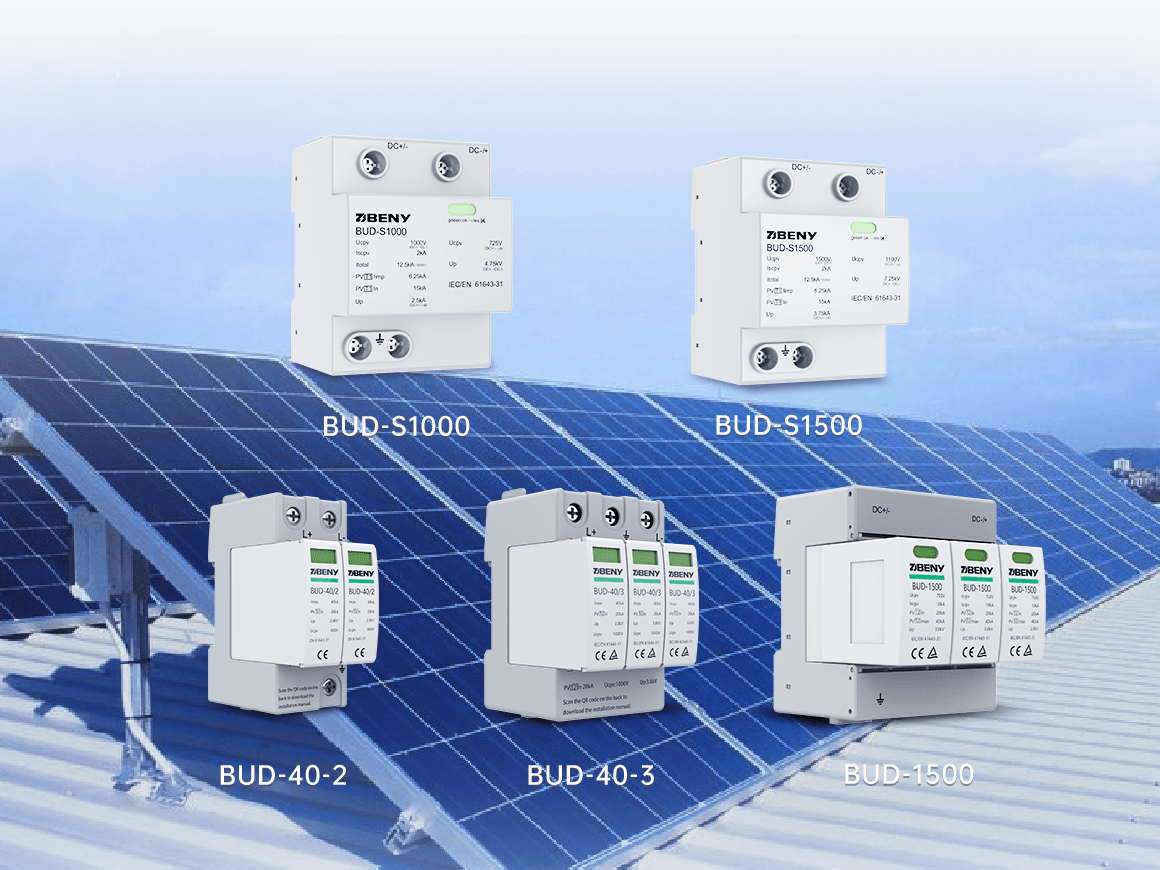
In lower current applications, the DC Miniature Circuit Breaker (MCB) has mostly replaced the older 20-amp or 30-amp fuses used in older parallel panel installations. These units are designed to be small and have a modular design that is designed to be mounted on standard DIN rails, which is why they are the default choice in PV Combiner Boxes and residential distribution boards.
Once the amperage exceeds the residential range into commercial solar systems and industrial (C&I) range, the restriction of an MCB is achieved. In this case, the Molded Case Circuit Breaker (MCCB) will be the required standard. These units are much larger and sturdier, housed in a strong, molded insulating case, and are intended to be bolt-mounted to withstand the mechanical forces of high-power switching.
Air Circuit Breakers (ACB) are used at the utility zenith, which covers large-scale power plants and Battery Energy Storage Systems (BESS), to control the upper end of the DC spectrum. These are not just switches but complicated arc-extinguishing systems with compressed air or vacuum technologies.
BESS Specialization: Standard ACBs are not always adequate in the context of storage. High-Speed DC Breakers are necessary to overcome the huge short-circuit currents that lithium-ion battery racks can deliver. These units need to respond in milliseconds to avoid disastrous thermal runaway.
Engineering Scope: Able to handle thousands of Amperes (2000A – 6300A).
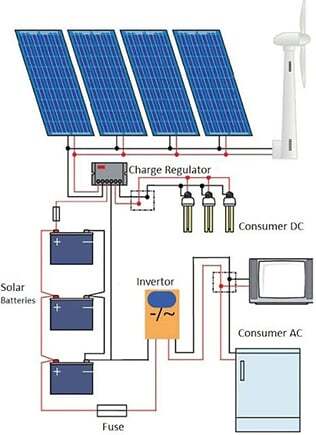
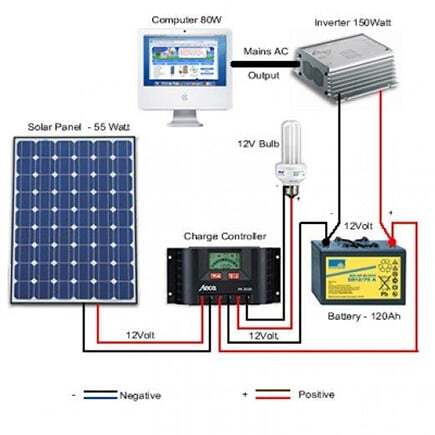
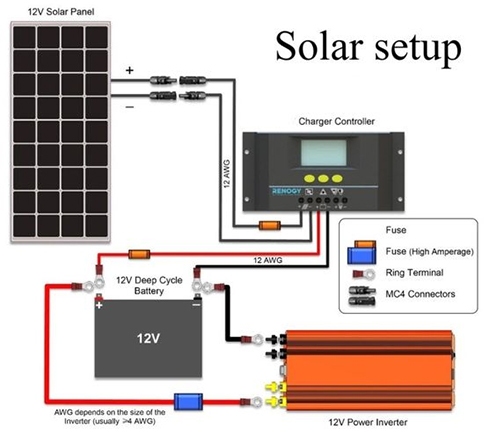
A solar PV system needs to be safeguarded at various points in the energy flow logic. The improper placement of breakers or the lack of separation between the AC and DC domains exposes the vulnerable parts of the system. Thus, we establish the use of circuit breakers in four vital areas.
The combiner box is the first point of defense in multi-string systems where a combination of multiple strings of panels is formed into one output. Before consolidation, a DC MCB should be fitted at the end of each string. This positioning is essential in particular to solve the problem of existing directionality as stated in safety measures.
When one of the strings is shaded or has a fault, the other strings can force current in the opposite direction into it. As it was mentioned, the accidental change of direction would cause serious safety concerns and damage the solar cells. Although a breaker does not actively steer current, it is a necessary protection against these hazardous feedback currents, which would otherwise cause fire and irreversible damage to the modules.
Going down to the energy storage section, the interface between the battery bank and the inverter/charger is the most challenging current carrying area of the whole system. This section allows the maximum flow of amperage, and a strong DC MCCB or high-rating MCB is required.
A breaker is included here, not only to guard the heavy-gauge battery cabling against thermal runaway caused by overcurrents, but also, perhaps more importantly, to offer a safe, physical method of disconnection. This isolation enables maintenance staff to work on the battery bank without the fatal exposure to live DC voltage.
The Main Inverter Input protection plays the role of the critical gateway between DC generation and AC conversion. This breaker is placed between the combiner box output and the inverter input, and it serves as the main DC switch of the entire generation side. It does not just perform overcurrent protection, but protects the sensitive internal power electronics of the inverter against external surges and provides a centralized isolation point to the entire DC distribution system.
Lastly, there are certain applications on the consumption side, especially to homeowners who use direct current directly to achieve efficiency. To reinforce this, installers are required to install separate distribution boards (fuse boxes) with dedicated circuit breakers, which are strictly different to the alternating current panel.
This is required in situations where appliances like LED lamps are dependent on the constant availability of direct current in order to operate. As these devices need a particular power environment, the DC circuit breakers in this case are used to protect these sensitive loads. They make sure that supply is kept in proper check and that any overloading in a lighting circuit is isolated as soon as possible without affecting the main system.
The choice of circuit breakers in solar PV systems is a field of study that is often neglected in favor of panel or inverter options. But carelessness in this case is expensive. A poorly chosen breaker will often fault because of thermal derating, causing overheating damage and, in the worst case, system fire.
The choice of a breaker is not a game of chance, but one of aligning specifications to the working conditions of the system.
The breaker voltage rating should be greater than the maximum Open Circuit Voltage (Voc) of the PV array, but at the lowest anticipated temperature. Moreover, the choice has to be in accordance with the topology of the inverter and the industry standards including UL508i and IEC60947-3.
The pole configuration is directly proportional to the number of strings in the isolator. One of the most important principles of DC isolation is that all live conductors must be de-energized at the same time.
The effect of the installation environment is one of the most important aspects that are usually absent in spec sheets. Solar isolators and breakers do not work in climate-controlled server rooms but in harsh conditions.
According to the National Electrical Code (NEC) and general engineering best practices, a breaker should not run continuously at 100% of its rating.
The Calculation Formula:
To determine the minimum ampere rating for your breaker (Ibreaker), you must apply safety factors to the PV array’s Short Circuit Current (Isc).

Simplified:

Example:
If you have a string of panels with an Isc of 10A:

You should round up to the nearest standard size, which would be a 20A DC Breaker.
In a market flooded with generic components, BENY stands as a manufacturer focused specifically on the complexities of DC solar protection. The distinction is not in marketing, but in engineering rigor.
With over 30 years of industry experience, BENY engineers solar system circuit breakers that bridge the gap between cost-efficiency and industrial-grade resilience. Our solutions are designed to handle the full spectrum of PV demands—from 12V to 1500V systems—supporting heavy-duty currents up to 630A with minimal energy loss.
Safety is intrinsic to our “Built to Endure” philosophy. Every breaker features advanced arc suppression barriers and a 6kA breaking capacity to neutralize faults instantly. We solve practical installation challenges with a non-polarized design that eliminates wiring errors and robust IP65 enclosures tested to perform in extreme climates ranging from -40°C to 85°C.
Backed by a 5-year warranty and 24/7 global support, selecting BENY means securing your infrastructure with a partner committed to uncompromising safety and longevity.
The photovoltaic investment has a silent protector, the solar circuit breaker. Whereas panels create value, breakers maintain it. The move to the more complicated high-voltage commercial arrays, as opposed to the simple residential systems, requires a change in our attitude towards component selection.
We should stop considering breakers as commodities and consider them as important safety assets. The installers can make sure that the systems are reliable by considering the unique physics of DC arcs, mapping breakers to their respective areas of application, such as combiner boxes to battery banks, and considering strict environmental standards and ampere ratings.
Circuit breakers are the high profile shield that many systems need. When the correct wiring instructions, safety measures and maintenance are observed, they ensure that the quality of the photovoltaic panel will last long.
To the individuals who want to have strong, certified and engineered DC protection solutions, BENY offers the hardware that they need to construct the solar systems of tomorrow- safely and efficiently.
Q: What type of circuit breaker is used for solar panels?
A: You must use a specialized breaker for solar panel protection, typically a DC Circuit Breaker. Do not use standard home AC breakers. DC electricity creates continuous arcs that are harder to extinguish than AC. Solar breakers (like DC MCBs or MCCBs) have specific arc-chutes and magnetic mechanisms designed to safely interrupt these high-voltage DC arcs and prevent fire.
Q: Do I need a breaker between solar panel and inverter?
A: Yes. A solar panel circuit breaker (or DC isolator) is required between the PV array and the inverter.. It serves two vital roles: it protects the inverter’s input from electrical surges or short circuits, and it provides a safe physical disconnection point for maintenance personnel to service the system without handling live wires.
Q: Where to put a breaker in a solar system?
A: Breakers should be installed at three critical protection zones: