The story of Electric Vehicles (EVs) has been completely changed as we enter the mid-point of the 2020s. We are not talking anymore about a change in transportation, we are seeing the beginning of a decentralized energy revolution. In 2026, for the modern ev owner, the car in the garage is a massive mobile gm energy powerbank for the whole house. As part of a global energy transition toward renewable energy sources, your vehicle has become a primary pillar of residential stability.
Vehicle-to-Home (V2H) technology has evolved beyond an experimental pilot project to a practical residential infrastructure. This guide is a technical and financial breakdown of V2H in the 2026 landscape, including the hardware, the vehicles, and the safety measures needed to transform your car into a primary energy asset.
Vehicle-to-Home (V2H) technology is a technology that turns an electric vehicle into a high-capacity mobile power station. In its simplest form, it facilitates a two-way power flow, where the electricity contained in a vehicle battery can be released into an electrical system of a home. This makes the vehicle an important or alternative source of energy in the whole household.
The technical reasoning of V2H starts with drawing dc power out of the high-voltage ev’s battery. As the typical household appliances use ac power, the power has to go through a conversion stage where it is inverted into useful AC electricity. Through smart charging protocols, the system manages energy usage to ensure the vehicle remains an important alternative power supply for the household. The energy is then converted and fed into the main distribution panel of the home. More importantly, the system should also incorporate a safety system that separates the home and the public utility grid. This eliminates the possibility of back-feeding, which is a hazardous condition, where the electricity is leaking back into the external lines and may cause damage to utility workers.
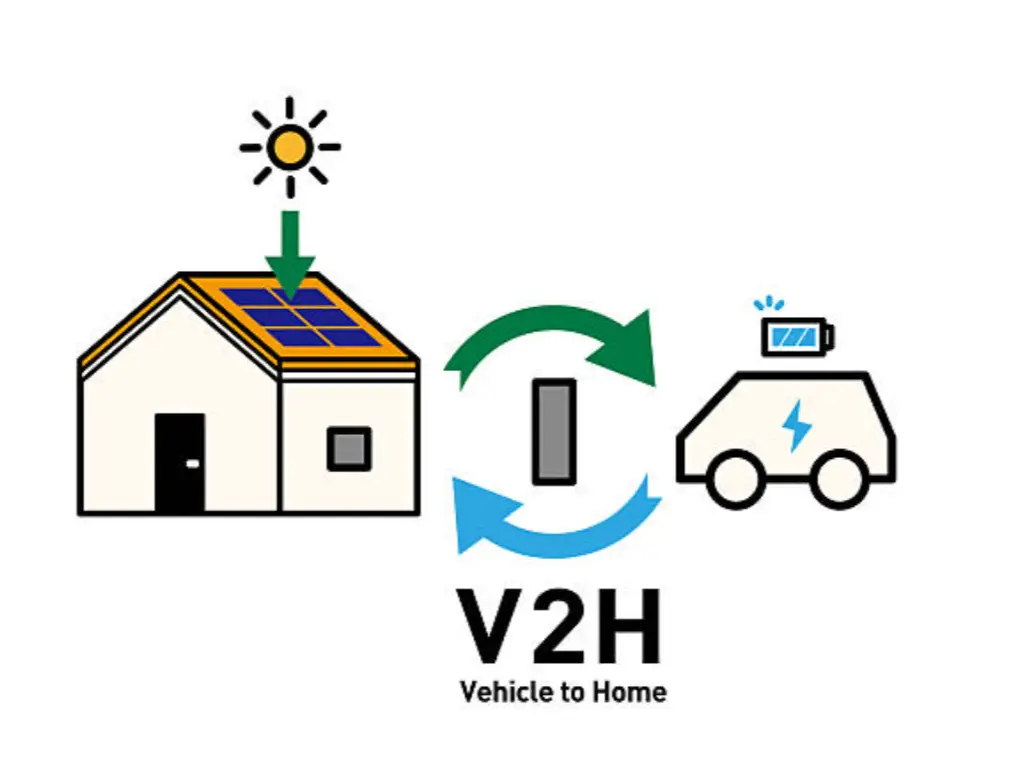
To enable bidirectional capabilities, you need a “hardware iron triangle” in your home. The three elements should be perfectly synchronized to release the energy stored in your EV and manage home energy usage safely.
The bidirectional charger is the core of the system, and it is the main controller of two-way power traffic, which is the feature that the standard charge-only units do not have. This is accompanied by an inverter which does the important job of transforming the direct current (DC) of the car battery into the alternating current (AC) that is needed by the appliances in the house. Lastly, a transfer switch or gateway is a safety firewall, which physically separates the home and the utility grid during discharge. This isolation cannot be compromised, since it eliminates the possibility of back-feeding, which is a hazardous condition where power is leaked back into public lines and poses a risk to utility workers. In the absence of this well-coordinated trio, the energy in the vehicle will be virtually wasted and will not be utilized in the home.
V2H has much more than mere convenience, as it provides a new dimension of energy resilience and financial efficiency. During a power outage caused by extreme weather conditions, a vehicle like the silverado ev rst can support critical medical devices and household loads for days, making it completely independent of a collapsing grid.
Economically, V2H can be peaked or arbitrated. Homeowners are able to charge their cars at off-peak times when electricity is cheapest and then use the stored energy to run the home at peak hours when energy costs are most expensive. V2H builds the final green energy loop to those who have solar panels: excess energy produced during the day is stored in the car and used at night, ensuring you have compatible solar panels maximizes this renewable energy cycle and greatly reducing the carbon footprint of the home.
Although V2L, V2H, and V2G are all subcategories of bidirectional charging, they have entirely different purposes and must be configured with different hardware. These differences are important to understand in order to select the appropriate solution to your energy requirements.
The 2026 landscape proves that bidirectional charging is no longer a luxury experiment, but a fundamental infrastructure feature. The market is now divided between the first movers, such as Ford and Tesla, who have perfected their residential power systems, and newcomers with General Motors and BMW that are stretching the limits of battery capacity and smart-grid interoperability.
Although the trucks such as the F-150 Lightning and Cybertruck dominate the high-output segment, which can run a house as a primary power source, the European market has experienced a wave of compatibility with Volkswagen and BMW, both of which now focus on software-driven energy management.
When comparing a particular model, this technical summary will determine the protocol and support level of the existing 2026 lineup:
| Model | Technology / Protocol | V2H Support Level |
|---|---|---|
| Ford F-150 Lightning | Intelligent Backup Power | Full Home Integration |
| Tesla Cybertruck | Powershare (NACS) | 11.5 kW High-Output |
| Cadillac Escalade IQ | Ultium Home (ISO 15118-20) | Multi-Day Power Reserve |
| Volkswagen ID.4 (3.5+) | DC Bidirectional (ISO 15118-2) | Managed Home Backup |
| Kia EV9 | E-GMP V2X Platform | Integrated Circuit Support |
| BMW iX3 (2026) | Neue Klasse (ISO 15118-20) | Full Smart-Home Sync |
In order to determine whether your electric vehicle is V2H-compatible, you need to go beyond the physical charging port and ensure that three key layers of compatibility are met.
First, ensure that your vehicle has an onboard charger that is specifically specified to support bidirectional or discharge in the technical manual. It is not just hardware, but your software version should be up to date as well, since many manufacturers have certain firmware updates required to open the communication protocols necessary to communicate with a home gateway.
The compliance with ISO 15118-20 is the most significant technical indicator. This protocol is the gold standard of 2026, and it allows the complicated digital handshake needed to make the integration of homes safe. This should not be confused with V2L (Vehicle-to-Load); V2L only energizes individual appliances through the outlet of a car, whereas only a car that is certified to ISO 15118-20 has the architecture to safely energize the main distribution panel of your home.

Risk of hardware lock-in was previously the main obstacle to V2H adoption. Unified standards today imply that a home energy system that you install on one vehicle will still work even when you change to a different brand several years later.
The ISO 15118-20 is the international digital language of 2026, enabling vehicles and chargers to communicate complex energy information without proprietary handshakes. This protocol is the secret sauce that makes the cost of hardware reset dramatically lower. Since your charger and car now share a common language, you can upgrade your EV without the costly hassle of tearing out and replacing your bidirectional charging station. It allows such functions as “Plug and Charge,” when the car and the home automatically agree on the discharge limits when they are connected.
Whereas the ISO manages the digital dialogue, the NEMA framework standardizes the physical safety and structural integrity of V2H hardware. These standards guarantee that the gateways and transfer switches, which separate your home and the grid, are constructed to a standard technical specification. This physical standardization enables third-party manufacturers to make high-performance equipment that is reliable and fits perfectly into standard North American electrical panels, providing homeowners with a wider selection and better prices compared to hardware that is only available at dealers.
This unified table offers an in-depth overview of the most popular electric vehicles that will be able to support Vehicle-to-Home (V2H) technology in 2026. With the help of standardized protocols, such vehicles can serve as primary energy reserves, and they can be easily integrated with the current home electrical systems.
| Vehicle Model | Primary Hardware Ecosystem | Communication Protocol | Max Discharge Output |
|---|---|---|---|
| Tesla Cybertruck | Tesla Universal Wall Connector | NACS / ISO 15118-20 | 11.5 kW |
| BMW iX3 (2026) | BMW Wallbox Professional | ISO 15118-20 | 11.0 kW |
| Volvo EX90 | dcbel Ara / Wallbox | ISO 15118-20 | 11.0 kW |
| Polestar 3 & 4 | dcbel Ara / Zaptec | ISO 15118-20 | 11.0 kW |
| VW ID.4 (3.5+ Software) | Enphase IQ Bidirectional | ISO 15118-2 (DC) | 10.0 kW |
| Ford F-150 Lightning | Ford Charge Station Pro | CCS / SunSpec | 9.6 kW |
| Chevrolet Silverado EV | GM Energy PowerShift | ISO 15118-20 | 9.6 kW |
| Cadillac Escalade IQ | GM Energy PowerShift | ISO 15118-20 | 9.6 kW |
| Kia EV9 | Wallbox Quasar 2 / Emporia | ISO 15118-20 | 9.6 kW |
| Hyundai IONIQ 7 & 9 | Wallbox Quasar 2 | ISO 15118-20 | 9.6 kW |
| Lucid Air | Lucid Connected Home | ISO 15118-20 | 9.6 kW |
| Nissan LEAF (2026) | Wallbox / Fermata Energy | ISO 15118-20 | 6.0 – 7.0 kW |
A late 2025 report shows that V2H users can save significantly on home energy usage bills. While there is an upfront cost, many manufacturers offer a promotional price for the enablement kit when purchased with a new vehicle like the first edition rst.
A late 2025 report by the MIT Energy Initiative gives tangible information on the economic and environmental cost of bidirectional charging. The analysis shows that V2H customers in high-tariff markets (including California, Germany, or Australia) can save 40 to 90 percent of their annual charging bills by using strategic load shifting and peak shaving.
The environmental ROI is also important. V2H-enabled households can cut their carbon footprint by about 12 to 15 tons of CO2 in five years by enabling homeowners to capture and store 100 percent of their excess rooftop solar energy instead of exporting it. This optimization transforms the house into a green ecosystem.
The size of the value is evident when comparing a Tesla Cybertruck (with a 123 kWh battery) to a conventional stationary battery system. In order to achieve the capacity of one Cybertruck, you would have to buy and install about nine standard home batteries.
A high-end 3-unit stationary battery installation is compared to a typical V2H upgrade to a Cybertruck in the following table:
| Investment Metric | 3x Stationary Batteries (40.5 kWh) | Tesla Cybertruck V2H (123 kWh) |
|---|---|---|
| Energy Capacity | ~40.5 kWh | 123 kWh (3x more capacity) |
| Estimated System Cost | ~$30,000+ (Installed) | $4,000 – $6,000 (Upgrade cost) |
| Cost per kWh Capacity | ~$740 / kWh | ~$40 / kWh |
| Primary Value | Emergency backup only | Transportation + Massive Storage |
| Typical Payback Period | 8 – 12 Years | 3 – 5 Years |
The rationale behind this investment is simple: you are buying the car to use it in its main purpose, which is transportation, and the huge battery pack is practically a free gift to your house. Rather than paying $30,000 or more to have a small stationary system installed, a $5,000 V2H upgrade will enable you to access a battery that is three times larger and already in your driveway. This arrangement is not only better in areas where the cost of electricity is highly volatile, but it also recovers itself in record time by arbitrating day-to-day energy.
By 2026, the hardware market is stable, with a number of flagship solutions that will connect your EV to your home electrical panel. The table below approximates the investment and possible annual returns of the most popular setups:
| Hardware Solution | Unit & Gateway Cost | Total Installation (Incl. Labor) | Est. Annual Savings |
|---|---|---|---|
| Tesla Universal Wall Connector | ~$2,400 | $4,000 – $5,500 | $1,500 – $2,300 |
| Emporia Pro V2X | ~$2,500 | $4,000 – $5,500 | $1,700 – $2,500 |
| Enphase IQ Bidirectional | ~$4,500 | $5,500 – $6,500 | $1,800 – $2,600 |
| Wallbox Quasar 2 | ~$6,440 | $7,500 – $8,500 | $1,600 – $2,400 |
Finally, V2H transforms the financial picture of an electric vehicle into a depreciating asset into a useful home appliance. You are buying a car to get around, and getting a huge, high-performance home battery as a free bonus, which will provide a degree of energy resiliency and independence that was once out of reach to the average homeowner.
The concern of many owners is that V2H will kill their EV battery, yet the data of 2026 proves this to be a myth. As a matter of fact, the low power consumption needed to power a home is much less stressful than the high-power requirements of driving or DC fast charging.
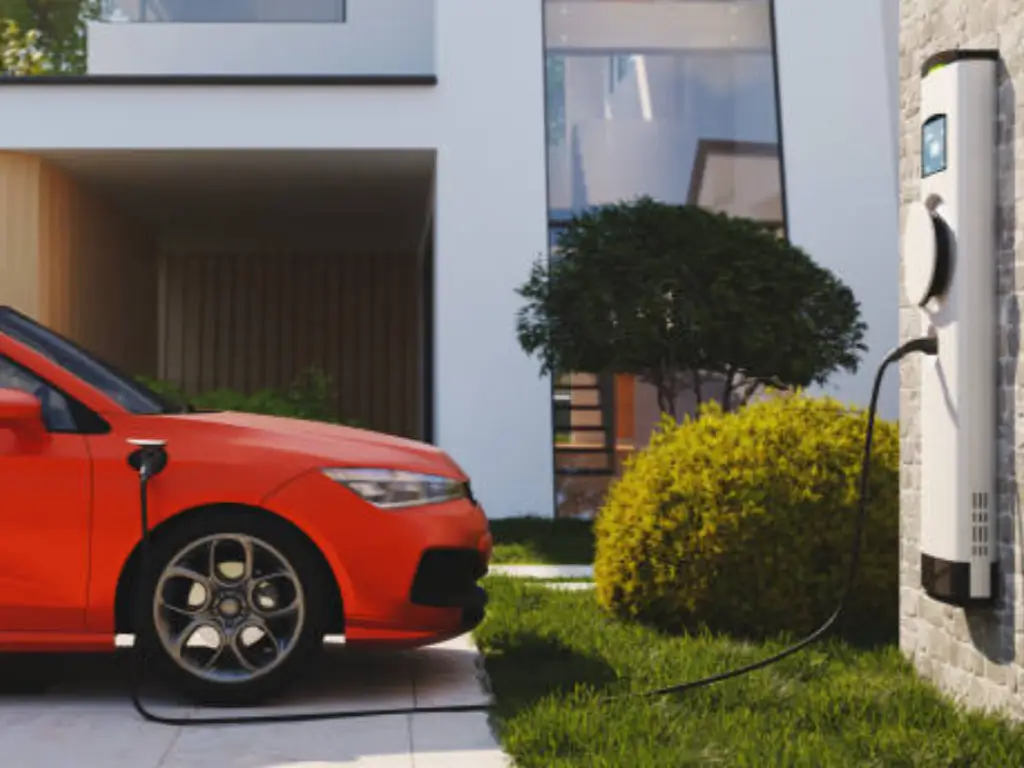
By 2026, most EVs will have Lithium Iron Phosphate (LFP) batteries, designed to be very durable, with 3,000 to 6,000 full cycles before serious degradation. V2H does not subject the battery to full drain, but rather uses shallow discharges (e.g. between 80% and 70%), which are controlled by an intelligent BMS (Battery Management System), and which remain within the chemical comfort zone of the battery, resulting in virtually no measurable wear relative to normal driving use.
Heat and discharge intensity are the main determinants of the health of a battery cell. DC Fast Charging charges the battery up to 250 kW or 350 kW, which causes enormous thermal stress and chemical pressure. V2H, on the other hand, is a low-rate discharge operation, usually drawing only 5 kW to 10 kW, or roughly the amount of power used by a few household appliances.
This is a low intensity that is chemically gentle. Actually, charging 10 kW to your house causes less internal battery strain than the high acceleration needed to merge into a highway. With the thermal load of V2H being so minimal under the shelter of a modern BMS, it is virtually invisible to the long-term health indicators of the battery.
The adoption of a V2H system in 2026 is a major home infrastructure initiative that goes way beyond the purchase of a new charger. The technical and regulatory environment is a complex environment that needs to be planned well to prevent unforeseen delays and cost escalation.
The main challenge facing most homeowners is the technical difficulty of retrofitting the existing electrical circuits. V2H, in contrast to conventional chargers, needs a complex “islanding” configuration capable of safely operating bidirectional power, and keeping the home electrically isolated to the grid in the event of an outage. Moreover, grid regulations differ widely by area; some states, such as California and Maryland, have simplified their interconnection regulations as of 2026, whereas others may continue to have lengthy approval periods on the use of so-called back-feeding technology, which could put your project months behind schedule.
One of the most common traps is to underestimate the loads V2H will impose on the main distribution panel of your home. Although a typical home may be fed on a 100A or 150A service, V2H systems generally export 40A to 50A of continuous current. This frequently requires a required upgrade to a 200A or 400A service to allow the busbars to sustain the concurrent load of domestic appliances and vehicle discharge of high power.
This can be a significant “invisible cost” financially. In 2026, the cost of upgrading a panel that was 100A to 200A is usually between 2,000 and 4,500 dollars, depending on whether your utility company will also have to upgrade the physical service drop (the wires between the street and your house). A certified electrician should do a “Load Calculation” before you buy hardware to find out whether your existing entry lines can actually handle bidirectional flow without overheating.
In order to legally use a V2H system, you need to receive a Permission to Operate (PTO) with your local utility provider. This is done by providing a comprehensive site plan that identifies your gateway and isolation switch, and the hardware must be the UL 1741 SA/SB (or the current 2026 SC) certified. The utility will frequently need to physically check the “islanding” capability, and ensure that your car will not accidentally re-feed power into a dead grid, which would be fatal to line workers.
Luckily, the financial strain will be usually compensated by the increased incentive schemes in 2026. The federal 30% Residential Clean Energy Credit has been made clear in the United States to cover bidirectional charging equipment and required panel upgrades. Also, most utilities are providing V2H Readiness rebates of between 1000 and 2500 dollars to customers who will consent to join demand-response programs. It is always important to check these credits and get your PTO prior to the final electrical inspection to make sure that your system qualifies in all available tax offsets.
Your home is now a high-voltage DC microgrid when you switch to V2H. This arrangement presents special risks that cannot be managed by conventional residential protection.
To successfully counter these invisible threats, the quality of your protection hardware is the most important. BENY is solving these issues with dedicated DC MCBs and SPDs designed to meet the high-stress requirements of V2H, and offer the uncompromising safety firewall needed to secure your home and your investment.

The development of V2H technology is radically changing the purpose of the electric vehicle as a mere means of transportation to a key distributed energy node. This change is the basis of the Virtual Power Plant (VPP), which is a collection of thousands of V2H-enabled homes, which are combined through software to act as one, giant utility-scale battery.
Your car is an intelligent asset in this decentralized ecosystem, which is an automated energy arbitrage. Rather than having utilities turn to carbon-intensive “peaker plants” during times of peak demand, they can tap small, synchronized portions of power in parked EVs to stabilize grid frequency and avoid blackouts. To the homeowner, this would turn your driveway into a source of income; smart home software can automatically charge your car when the renewable energy is in abundance and sell it to the grid when prices are high.
With the shift to a more resilient energy economy, V2H is to become a part of the smart home and make every vehicle a protector of grid stability. You are no longer a passive consumer, you are an active participant in a decentralized power network that compensates you on the energy you store.
In 2026, Vehicle-to-Home technology has passed the stage of early adopters and is now a well-developed, economically viable energy resilience strategy. With the help of the huge battery you already have, your EV, and the protection of an industrial quality, such as the one provided by BENY, you can turn your house into an energy fortress. You are not merely driving the future, you are in it.
🚗 What cars are V2H enabled?
By 2026, the Tesla Cybertruck, Ford F-150 Lightning, Nissan Leaf, Kia EV9, Volvo EX90, and Ultium-based models such as the Silverado EV and Cadillac LYRIQ will have V2H capability as standard or optional.
⚡ Will Tesla allow V2H?
Yes, Tesla has officially added V2H with its own Powershare technology, which is already operational on the Cybertruck and is being implemented as software updates to 2024 and later Model 3 and Model Y vehicles with bidirectional hardware.
💰 What is the cost of a V2H system?
The average cost of a V2H installation is between 5,000 and 15,000, including the bidirectional charger unit (1,500-6,000), home integration hardware (2,000-5,000) and professional electrical work to upgrade the panel.
✅ Is V2H worth it?
V2H offers superior value by giving you multi-day emergency backup, savings on peak-shaving electricity, and a better payback on your EV by using its huge battery as a free alternative to dedicated stationary home storage.
© 2026 Vehicle-to-Home Technology Guide – Professional EV Charging Solutions