The debate on renewable energy has changed radically. Placing solar panels on your roof is no longer the last step towards energy independence but it is the beginning. With the shift in net metering policy and grid instability becoming a more common reality by utility companies, the production of your own electricity with no means of storage exposes your property to vulnerability. You are producing excess solar energy when you are not at home to consume it, losing the ability to save that excess energy for later use, and purchasing power back at the grid when the rates are at their highest.
This inefficiency is addressed by solar battery storage. It relies on stored energy to save your surplus production during the day and reserves it to be used at night, giving you peace of mind during peak hours, or during unexpected blackouts. This guide is a professional breakdown of all the requirements needed to successfully install a battery storage system into your property. We will discuss the process of choosing the appropriate technology, the actual financial investment breakdown, the importance of professional installation, and the hard safety hardware that is necessary to secure your infrastructure.

The complete dependence on the conventional power grid has turned out to be a huge financial burden to property owners looking to lower their utility bills. The utility companies in the nation are actively implementing time-of-use rate plans, which deliberately spikes the price of electricity in the late afternoon and evening hours when residential and commercial demand is at its highest point. The lack of local storage means that the solar panel owners must go through this costly cycle, selling their precious daytime energy to the grid at a few cents a kilowatt-hour, only to buy it back a few hours later at a high price, driving up overall electricity costs.
In addition to the financial mathematics, there is the unquestionable fact of grid reliability. Blackouts and frequent power outages are on the rise due to extreme weather, such as heavy rainfall, and aging infrastructure. A typical solar panel array is programmed to close completely in case of a grid failure to ensure the safety of utility workers who are fixing the lines. The inclusion of a battery storage system breaks this entire reliance, providing reliable backup power. It enables your property to be a self-sufficient microgrid, keeping power to your essential appliances, security systems, and communication networks, no matter what is occurring on the municipal lines outside. Battery upgrade of your system is a direct translation of guaranteed continuity of operations and predictable energy overhead.
When choosing the right energy storage system, it is necessary to go beyond brand names and concentrate on the specific needs of your property. The initial important step is to compute your energy needs depending on your expected outage time and daily usage patterns. You need to determine your essential loads, which are the circuits that you must have operating in the event of a blackout, e.g., refrigeration, well pumps, air conditioners, heat pumps, medical equipment, or basic lighting. You can set a minimum capacity requirement for your kWh battery by multiplying the wattage of these devices by the number of hours you plan to operate them. This helps dictate the proper battery size. Never forget to add a buffer, because repeatedly discharging a battery to zero will lower system efficiency and have a serious negative effect on its working life, ultimately reducing overall battery lifespan.
Lithium Iron Phosphate (LiFePO4) is the unquestioned marathon winner in the energy storage sector. The conventional lead-acid batteries are bulky, need constant attention, and can be discharged to approximately half of their capacity before permanent damage is caused. In sharp contrast, LiFePO4 technology has high thermal stability, zero off-gassing and can safely discharge up to ninety percent of the stored capacity. This new chemistry offers thousands of cycles of dependable power with no safety hazards like the older types of batteries.
Another significant challenge is integration with your solar setup and existing equipment. The industry is split into two different approaches to the connection of storage to your panels utilizing either AC power or DC power connections, which dictate how electricity flows through your current inverter.
| Feature | Alternating Current (AC) Coupled System | Direct Current (DC) Coupled System |
|---|---|---|
| Operational Efficiency | Slightly lower due to multiple power inversions (DC to AC, AC to DC, then back to AC). | Highly efficient because solar power remains in DC format until it reaches the home circuits. |
| Installation Complexity | Straightforward and fast. Operates independently of the existing solar wiring. | More complex and labor-intensive. Usually requires rewiring the existing solar connections. |
| Retrofit Compatibility | Excellent. Can be added to almost any existing solar array regardless of the inverter brand. | Poor for retrofits. Typically requires completely replacing the existing solar inverter. |
| Ideal Application Scenario | Adding storage to a home that already has a functioning solar panel system installed. | Brand new installations where solar panels and batteries are installed simultaneously. |
The retail cost of a battery unit is a small part of the overall financial investment. To have a complete picture of your investment, you need to consider the obvious hardware costs as well as the invisible logistical costs that will be necessary to safely and legally bring the system online. The hardware itself will usually cost approximately half of the total cost, but the infrastructure and specialized labor will soon push the final figure up.
A full upgrade of the main electrical panel is needed in many older properties to support the new loads and complicated wiring of a storage system. Also, allowances of fees by your local municipality, specialized electrical work, and possible trenching of conduit runs are significant line items that need to be included in your initial budget.
| Expense Category | Estimated Market Cost Range | Description of Expenses |
|---|---|---|
| Battery Hardware | $7,000 – $14,000 | The physical battery unit, internal chemistry cells, and integrated battery management system. |
| Inverter Equipment | $1,500 – $3,000 | Required if utilizing a DC-coupled system or if the chosen battery does not include an onboard inverter. |
| Panel Upgrades | $2,000 – $5,000 | Upgrading a 100-amp service panel to 200 amps, or installing a dedicated critical load sub-panel. |
| Specialized Labor | $2,000 – $4,500 | Wages for certified solar electricians to mount, wire, and configure the heavy equipment. |
| Permits & Interconnection | $500 – $1,500 | Municipal building permits, utility interconnection agreements, and final inspection fees. |
Luckily, government incentives are a great relief to the financial burden. The Federal Solar Investment Tax Credit serves as a financial shield that cushions your investment payoff enabling you to claim thirty percent of the total cost of installation including labor and other auxiliary electrical upgrades directly off your federal tax bill. When you add this federal credit to aggressive state-level rebates and local utility battery enrollment programs, the net cost of the system is reduced by a significant factor, the payback period is reduced by several years.
Tutorials on how to install residential energy storage are all over the internet, and it is a project that can be completed over the weekend. This is a risky and legally questionable myth. This is high-voltage direct current electricity and it does not act like normal household wiring. Direct current does not inherently arc when disconnected, so a simple wiring error can immediately produce a continuous, very destructive plasma arc that can cause serious burns, blindness or instant structural fires.
In addition to the physical risk, the regulatory compliance is extremely high. Electrical codes specify the location of disconnects, the ratio of fill in conduits, and the calculation of loads, which are not within the capability of an average person. An installation that does not have the signature and license number of a certified electrician will fail outright by municipal inspectors. Moreover, any self-installation will automatically cancel the warranty of the manufacturer of your very expensive battery hardware. In case a homeowner installs a battery and it causes a property fire, the insurance companies have the legal right to reject the claim on the basis of illegal, unlicensed electrical work. Safety, legality, and financial protection are all mandatory requirements that require professional installation.

The real implementation of an energy storage system is a rigid order of events to guarantee the maximum performance and the total safety. It starts way before any hardware is delivered to your door.
It starts with a profound analysis of your historical utility data. Designers examine your energy bills to determine high-draw appliances and peak usage times. Instead of estimating, they draw a map of what you actually want to continue operating in an outage, be it the entire home being backed up or just the essentials such as refrigerators and medical equipment. This granular load profile will calculate the exact kilowatt-hour (kWh) capacity you require, so you will not pay more than you should to have excess storage, nor will you have a battery that will run out too quickly during a blackout.
Engineers physically survey your premises to determine the structural integrity and map the existing electrical infrastructure before any equipment is ordered. They identify the safest conduit routing and make sure that the selected location has a high level of ventilation to manage thermal conditions. This field data is then transformed into very detailed single-line diagrams. It is not negotiable to submit these plans to your local building department early; getting municipal permits will make sure that your system is built to the letter of the fire and electrical code, and that you do not have to make costly and time-consuming changes to your system in the middle of the project.
This is an important step that is not taken into consideration by homeowners but is compulsory. You will also need to seek grid interconnection with your utility company, in addition to municipal permits. The utility company should consider the effect of your battery system on the stability of the local grid. More to the point, they should ensure that your system will automatically shut down exporting power in case of a grid failure, which would create a hazardous “islanding” effect that would electrocute linemen who would be fixing the wires. Without this signed agreement, your system is not legally allowed to be connected to the grid.
To integrate a battery, you need to determine the way it will interact with your solar panels. When retrofitting a battery to an existing solar array, an AC-coupled system is generally used since it is compatible with your existing microinverters. On the other hand, in the case of new, concurrent solar and battery systems, a DC-coupled system is usually better. It does not incur the efficiency penalty of transforming direct current into alternating current and vice versa and reduces energy loss and maximizes the real power you get out of the sun.
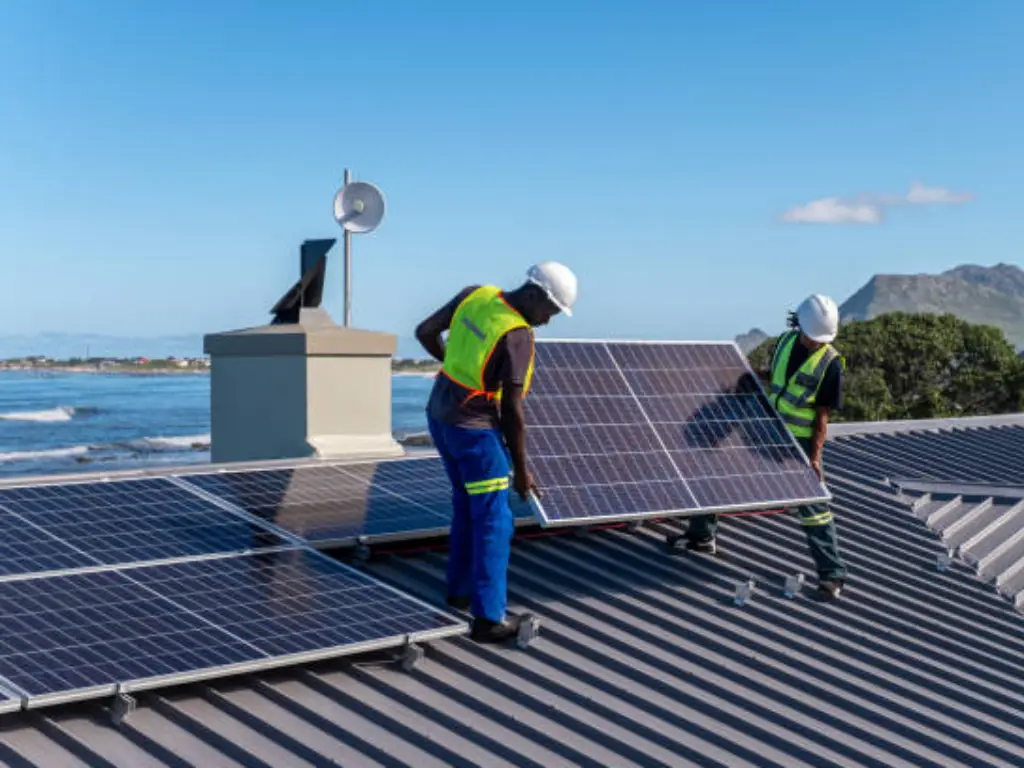
Certified electricians fix the heavy battery modules on installation day to load-bearing walls or reinforced concrete pads. The most important technical task is done at the electrical panel where the team installs a backup gateway switch. This element is mandated by law since it separates your house off the grid in case of a blackout, so that your battery does not send live and dangerous voltage back onto the street lines and harm utility workers. After wiring, technicians start the software and simulate power failures to make sure that your home switches to battery reserves immediately and perfectly.
The physical installation is not the end. A building inspector of the municipality should go to the site to ensure that wire gauges, conduit runs, and safety labels are exactly as per the approved designs and national safety standards. After the city has formally accepted the work, your utility provider examines the final documentation to grant Permission to Operate (PTO). This is an official authorization that will enable your storage system to coordinate with the local grid, which will enable your home to be completely energy independent.
The modern lithium storage systems are highly automated, yet not totally free of the environmental and maintenance requirements. The chemical reactions that store and release your power are very sensitive to their physical environment and failure to consider these needs will drastically reduce the life of your investment.
The requirements of proper ventilation and temperature control are not negotiable. During the discharging and charging process, batteries produce heat. When placed in an unventilated garage or a mechanical room that receives direct afternoon sunlight, the internal temperature of the cells may rise to unsafe operating temperatures. This increases the rate of chemical degradation and in worst-case scenarios may cause thermal runaway, an uncontrolled self-heating condition that causes disastrous equipment failure. The ambient temperatures in the area of installation should be within the recommended range by the manufacturer, and may necessitate active exhaust fans or special climate control.
The second pillar of safety is routine system voltage testing and visual inspection. Although the internal battery management software continuously checks the health of the cells, property owners are required to physically check the exterior enclosures to identify any physical swelling, ingress of condensation, or damaged wiring conduits. Hiring someone to conduct a diagnostic test on the transfer switches and grounding lines annually will guarantee that the system will respond safely and immediately the moment a grid failure happens.
In the case of energy storage systems installed in the outdoor commercial or aggressive industrial conditions, the physical security of the hardware is as important as the electrical engineering. These systems are driven by a strenuous duty cycle, continually charging and discharging large amounts of energy to equalize loads in facilities. This constant frequency of operation requires an enclosure that is capable of sustaining structural integrity and dealing with the resultant thermal output.
High-end industrial battery cabinets should be designed as an impregnable fortress against the extremes of the environment and unauthorized human intervention. This demands robust, explosion-resistant construction that is rated to high standards of National Electrical Manufacturers Association to prevent the entry of dust, driving rain, and corrosive elements.
Normal locking systems are extremely inadequate to protect the very delicate parts within. Commercial storage enclosures of high tier are based on advanced multi-point locking systems operated by a strong paddle latch. The paddle latch is inset into the housing, making it impossible to tamper with or use force, and at the same time forces steel locking rods into the top, bottom, and side frame of the door. This multi-point contact forms a uniform, airtight seal over the entire gasket, keeping the internal climate constant and the high-voltage hardware out of the reach of external environmental factors and possible vandalism. The exterior is half the battle and that is why BENY energy storage systems combine this rugged hardware protection with the best internal battery chemistry in the industry.

A shift to a solar-plus-storage model is a clear step towards financial predictability and operational security. Knowing the exact capacity that your property requires, the actual extent of the installation expenses, and the rigid environmental standards, you will be in a position to maximize the payoff of this huge investment. Do not cut corners by trying to do unlicensed work. Trust in established technology, demand professional installation and seize total control of your energy future today.
💰 How much does it cost to install a solar battery in your home?
The total cost generally ranges from $10,000 to $20,000, varying based on battery capacity, chosen coupling architecture, labor rates, and available local tax incentives.
🔋 Can I add batteries to my existing solar system?
Yes, you can successfully integrate a battery into an active array by utilizing an AC-coupled architecture that works alongside your current microinverters.
📍 Where does a solar battery need to be installed?
It requires a stable, well-ventilated, and climate-protected environment, most commonly a garage, utility room, or a shaded exterior wall mounted on a reinforced concrete pad.
⏱️ How many years will a solar battery last?
Most modern residential solar batteries provide reliable power for 10 to 15 years, depending heavily on their daily depth of discharge, thermal management, and total cycle count.
© 2026 Solar Battery Installation Guide – Professional Energy Storage Solutions