The transition to electric mobility is often discussed in terms of battery range, charging speeds, and environmental impact. However, for the homeowner, the most critical shift occurs within the electrical infrastructure of the house itself. Installing an Electric Vehicle (EV) charger is not merely like plugging in a new appliance; it is a significant addition to your home’s electrical load that requires a nuanced understanding of safety protocols. Among these, PEN Fault Detection stands as perhaps the most misunderstood yet essential safety feature in modern charging systems.
For many EV owners, the term “PEN fault” sounds like obscure technical jargon. Yet, in the context of the UK and European power grids, it represents a specific physical risk that, if left unaddressed, could turn a routine charge into a hazardous event. This article aims to pull back the curtain on this technical requirement, offering a clear-eyed analysis of the risks, the regulations, and the solutions available to ensure your home remains a sanctuary of safety.
What is a PEN Fault and Why It’s a Serious Risk
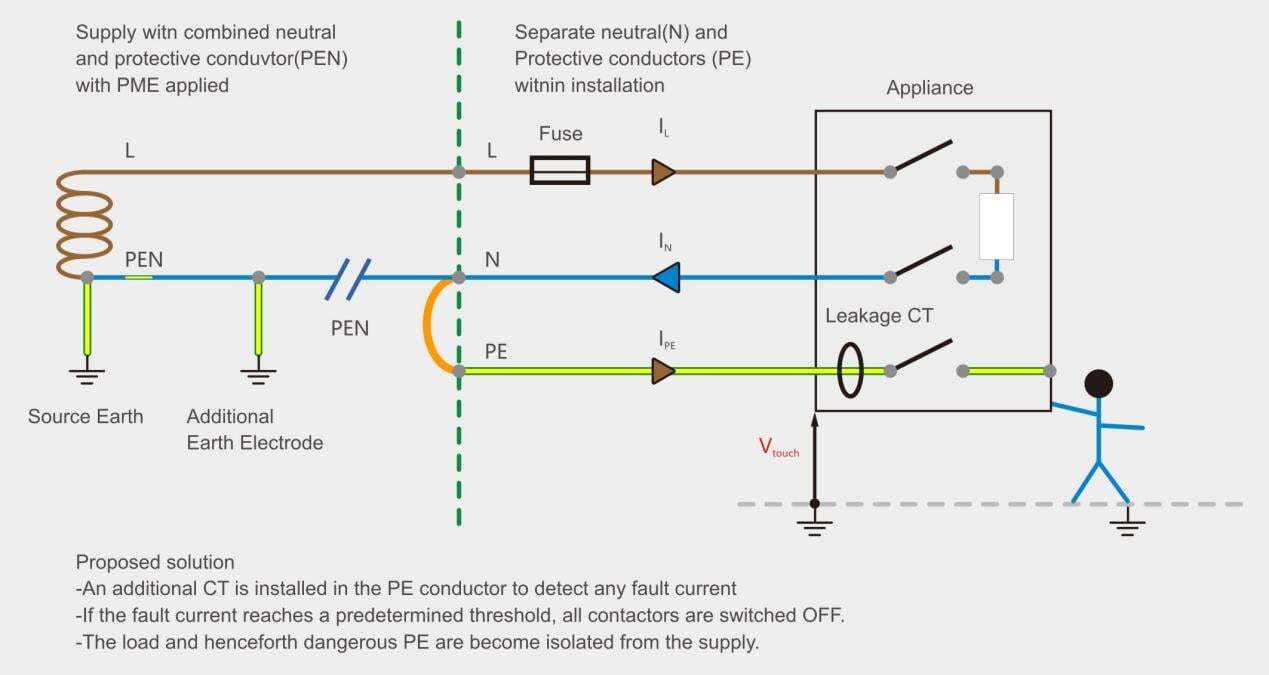
To get a picture of a PEN fault, we have to examine the way electricity enters the majority of UK homes. The majority of residential buildings use a system called TN-C-S (Terra Neutral-Combined-Separated), commonly called PME (Protective Multiple Earthing). In this arrangement, the role of the “Neutral” wire (carrying current back to the source) and the “Protective Earth” wire (giving fault currents a safe path) are merged into one conductor known as the PEN (Protective Earth Neutral) conductor until they arrive at your property.
When this combined conductor is broken or disconnected above your home, it is a PEN fault. This is commonly referred to as a Broken Neutral event. In a normal state, the PEN conductor maintains the metal casing of your appliances at 0 volts (Earth potential). But when the PEN conductor breaks, the Earth in your house is no longer in contact with the real ground.
The effect is direct and threatening. Since the circuit is open, the current returning has no place to flow. It will be supported by the neutral side of your appliances and to the earthing system. This could result in some flickering of the light or slight damage of equipment in a normal house. However, when an EV is charged, the metal chassis of the car is attached to that now-weakened earth wire. Your whole car is a kind of bridge that 230 V of electricity is trying to find its way to the ground. Should you touch the car standing on the driveway, your body would be in that circuit and you would get a potentially fatal electric shock.
How PEN Fault Detection Works: The Technology Behind the Safety
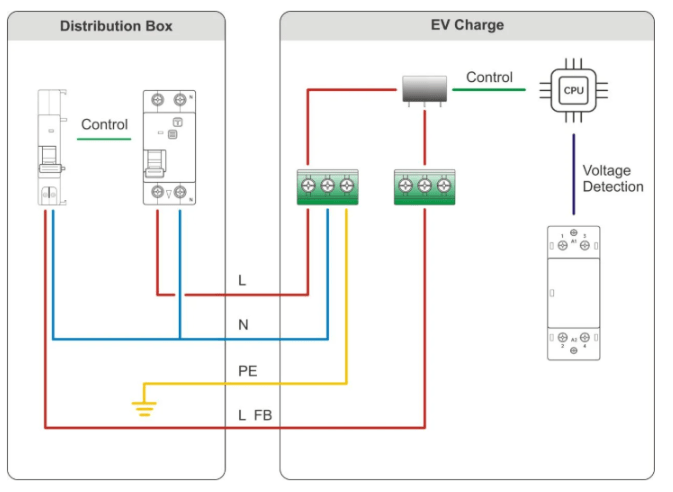
The brain of the EV charger is the solution since we cannot always avoid the failure of the infrastructure of the grid. Modern PEN fault detection is an advanced monitoring system that is intended to serve as a digital watchdog, continuously checking the quality of the incoming power provided by the distribution network operator (dno).
The technology mainly works through the supply voltage monitoring. The difference between the live and the neutral wires of a healthy TN-C-S system is supposed to remain within a given range- usually between 207V and 253 V in the UK. A damaged PEN conductor virtually always results in this voltage varying unpredictably beyond these limits or a measurable potential difference between the neutral and the local earth.
The detection circuit detects a voltage deviation that corresponds to the profile of a PEN fault, and causes a protective response. In order to provide complete safety, the charger has to carry out what is referred to as Triple-Pole Isolation. This implies that it does not only switch off the power supply on the live wire, but also breaks the Live, Neutral and Earth connections to the vehicle. This complete isolation means that although the earthing system of the house may be live because of a grid failure, the car will still be electrically floating and safe to touch. In the absence of such a rapid action, an individual handling the vehicle may be subjected to leakage currents of more than 30mA or even 100mA- currents that cause paralysis of the human body, which cannot release its grip. This has to occur quickly- say in five seconds- to ensure high safety standards.
When PEN Fault Detection Is Required: UK Regulations and Compliance
You may ask yourself whether this is a nice-to-have feature. The response in the UK is a resounding no. Strict requirements of EV charging installations are contained in the IET Wiring Regulations, namely BS 7671 (the 18th Edition and its Amendments).
Section 722 of these regulations states that any EV charger mounted on a PME (TN-C-S) earthing system should have a means of ensuring that the vehicle does not become live in the event of an open PEN conductor. In the past, the only method of compliance was to install a physical earth rod, a long copper spike driven into the ground. Amendment 2 of BS 7671 has however updated these rules and now explicitly permits the use of on-board or integrated PEN fault detection devices as a primary method of compliance.
Compliance does not only mean following the law, but it is also about liability and insurance. In case of fault in the case of an uncertified charger installed, the home insurance companies might not cover the damages on the grounds that they did not comply with the national safety standards. To the EV owner, the only option available to them is to select a compliant charger to be sure that their home electrical certificate (EICR) is valid and their family is safe.
Built-in PEN Detection vs. Earth Rods: Which Is Best for You
When you are installing a charger, you usually have two ways to safety. Both are compliant, but in very different ways.
Traditional Earth Rods
The conventional technique is to insert a metal rod deep into the ground at the charging point and then attach it to the earthing system of the charger.
- The Pros: It is an entirely passive, physical remedy that is not based on electronics.
- The Cons: It is usually unrealistic and costly. The installation of an earth rod involves excavation of driveways or gardens. Moreover, you should make sure that the rod is not too close to other buried metalwork (such as gas pipes) to cause “potential interference” which can be a logistical nightmare in urban areas. This in rocky terrain becomes a complicated engineering job that involves industrial equipment to cut through the strata. Furthermore, rods may be corroded with time, and they become useless without the knowledge of the homeowner.

Built-in Protection
The contemporary, digital counterpart is integrated PEN fault detection.
- The Pros: It does not require excavation and the unsightly copper rod protruding out of the ground. It saves a lot of time and labor expenses on installation. Since it is an active monitoring system, it is also able to give data and alerts to the homeowner through an app in case the grid is not performing well.
- The Cons: It depends on the quality of the internal parts of the charger. That is why it is so important to select a well-known manufacturer, not every detection circuit is equal. To those who want this particular peace of mind, make sure that the model number contains the -E suffix in the model number- the signature of the integrated PEN fault detection technology of BENY.

To the great majority of the modern householder, inbuilt protection is the better alternative, with a more intelligent safety surveillance and a cleaner installation.
What Makes a Reliable PEN Fault Protection System
With the shift to the digital detection of the traditional physical rods, the responsibility of final safety is placed solely on the hardware and software within the charger. A good system is much more than a relay that clicks off; it is an advanced, industrial-quality guard that can endure the stresses of high-current charging over a period of many years.
The gold-standard PEN fault protection system must be evaluated based on three criteria:
- Precision and Speed: The system should be sensitive enough to pick up small voltage imbalances but smart enough to ignore small amounts of noise on the grid that do not present a safety hazard.
- Triple-Pole Disconnection: There are cheaper chargers that disconnect only the live and neutral lines. A really safe system should not be connected to any of the three, even the earth, to completely isolate the car on a faulty house ground.
- Industrial-Grade Components: Since the PEN detection circuit is never switched off, it needs to be constructed using high-quality, industrial-grade semiconductors that will not wear out during thousands of charging cycles.
In order to assist you in assessing these pillars in relation to industry requirements, the following table identifies the technical specifications that distinguish between a basic charger and a high-performance safety device:
Technical Benchmarks for Reliable PEN Fault Protection (BS 7671)
| Feature / Parameter | Standard Requirement / Threshold | Safety Significance |
| Operating Voltage Range | 207V – 253V (UK Standard) | Ensures charger stability within standard grid fluctuations. |
| Fault Trigger Threshold | Voltage >253V or <207V | Detects voltage drift caused by a Broken Neutral (PEN fault). |
| Response Time | < 5 Seconds (BENY: 0.1s) | Rapidly isolates power to prevent fatal shocks; BENY provides near-instant protection. |
| Isolation Technology | Triple-Pole Isolation (L, N, PE) | Simultaneously disconnects all paths to ensure total physical separation. |
| Leakage Current Limit | < 30mA (BENY: < 1mA) | Far below the 30mA safety threshold of human perception. |
| Compliance Basis | BS 7671 Section 722 | Meets the latest mandatory UK and European safety regulations. |
Benchmark Note: While the industry standard allows a 5-second response, BENY’s integrated chips achieve full isolation in under 0.1 seconds, restricting potential leakage to below 1mA—far beneath the level of human perception.
How BENY Integrates Advanced Safety in EV Chargers
At BENY, we believe true safety is found in the details others overlook. Our engineering philosophy moves beyond simple compliance, integrating a “Triple-Layer Safety Fortress”—combining PEN fault detection, a Type B RCD, and a dedicated Emergency Stop Switch into a single, cohesive defense.
We further eliminate hidden risks like Contactor Adhesion, where our main control chips continuously monitor output voltage to ensure the system is never live post-session. We understand, however, that every home’s infrastructure is unique. This is why we have made this industrial-grade intelligence available in two formats: it is integrated directly into our ‘-E’ series chargers for seamless daily use, or housed within our modular BCPN-P1/P3 Combiner Boxes for those seeking to upgrade complex or multi-charger setups. By condensing these sophisticated protections into a “plug-and-play” format, BENY acts as a silent, vigilant guardian, ensuring your family’s safety is never a matter of compromise.
Troubleshooting: What to Do If Your Charger Displays a PEN Fault Alert
When your charger abruptly ceases to work and shows a PEN Fault or Voltage Error light, you may think that it is frustrating. But this warning is that the system has probably rescued you out of a risky situation.
- Do Not Unplug the Car Immediately: When you think there is a serious electrical fault, do not touch the metal components of the vehicle or the charger connector until you have switched off the power at the main consumer unit (fuse box).
- Test Grid Fluctuations: A temporary brownout or voltage drop in the local area often causes a PEN Fault alarm to be activated. In case the light clears after several minutes, it could have been a temporary grid problem.
- See an Electrician: In case the fault continues, it means that there is a real fault with the earthing of your home or the local grid. Get a qualified electrician to conduct an earth loop impedance test.
- Check the App: When using a smart charger, check the logs in the app. It will frequently provide you with the exact voltage reading that caused the shutdown, which is priceless information to an electrician.
Common Myths and Mistakes About PEN Fault Safety
Although it is important, there are still a number of myths regarding PEN faults that may result in unsafe decisions.
- Myth 1: I have a new house and I do not require PEN detection. * Reality: PEN faults are found in the cables of the utility in the street or on the poles. Your house is not old enough to save you in case of a grid-side failure.
- Myth 2: The internal software of the car will save me. * Reality: The car is able to check its battery, but it is not able to unplug its own chassis to the earth wire of the house. The car can only be isolated by the charging station to the electrical system of the home.
- Myth 3: Earth rods are safer than electronics. Reality: A rusty or shabby earth rod may give an illusion of safety. A good digital detection system offers active real time monitoring which cannot be matched by a copper spike.
Conclusion
The fact that EV charging is so complicated today is a testimony to the level of technological advancement in the automotive industry, and it is also a lesson that safety should never be assumed. PEN Fault Detection is the unseen barrier that exists between your car and the natural susceptibility of the aging electrical grid.
Knowing the TN-C-S system nature and the dangers of a broken neutral, EV owners will be able to make more informed decisions. It does not matter whether you are selecting a classic earth rod or a more advanced integrated solution, the focus is the same compliance, reliability and peace of mind. With the future of green becoming a reality, it is important to make sure that the road to sustainability is the road to safety by selecting high-quality, professionally engineered hardware, including the solutions offered by BENY.