Electrification of the transport industry is a paradigm change in the distribution of energy, where the centralized fuel model is replaced by the decentralized power grid model. To investors and commercial operators, the choice to install EV infrastructure is not a matter of technology adoption but a capital allocation and long-term asset management exercise. Level 3 charging, also known as DC fast charging or a DC fast charging station, is a unique asset category in this landscape relative to its slower predecessors.
Whereas Level 1 and Level 2 chargers are used to serve the “dwell-time” economy (charging when the vehicle is parked overnight or during work), Level 3 charging is used to serve the “mobility” economy, enabling long-distance travel and high turnover of the fleet. But the ability to provide high-voltage energy in minutes instead of hours is a high price. Level 3 infrastructure is a complicated cost structure that includes high initial hardware costs, variable costs of EV chargers installation based on grid capacity, and advanced operational costs. This paper presents a strict examination of these expenses to establish the break-even horizons and the potentials of the return on investment (ROI) to the potential stakeholders investing in an EV charging station.

Level 3 charging is the highest level of modern commercial EV charging technology. In contrast to Level 1 and Level 2 systems, which use AC power and depend on the onboard converter to convert power into Direct Current (DC) to power the EV battery, Level 3 stations do this conversion off-board. This circumvents the bottleneck of the onboard charger and the station can provide DC power to the battery management system of the vehicle.
The outcome is a significant decrease in charging latency. A typical Level 2 charger may take several hours to charge a battery, whereas a Level 3 charger can restore an electric vehicle (EV) to 80 percent of its charge in about 20 to 30 minutes with a 10 percent state of charge. When Level 1 charging is like filling a reservoir with a garden hose, Level 3 is like opening a sluice gate; the amount of energy transfer is exponentially greater. This is the main value proposition of the technology, which warrants the complicated engineering and increased costs to support it.
Economically, Level 3 stations have unique benefits that make them adopted by the modern EV owner:
The technical divergence must be known to comprehend the cost difference. Level 1 charging uses regular 120 V residential sockets, with insignificant power transfer only in the case of long-duration parking. Level 2 is 240 V (like large appliances) and provides a convenient workplace or residential use option, functioning effectively as a home EV charger.
Level 3, however, is used with voltages of 400 V to 900 V+. This is not just an upgrade, it is a new branch of electrical engineering. It needs high-duty liquid-cooled cables to dissipate heat, advanced software to interface with the EV’s battery management system (BMS) of the vehicle, and strong safety features to deal with high-amperage arcs. As a result, the charger cost profile of Level 3 is not linear to Level 2; it is exponential, which is the nature of the equipment of industrial grade.
The first capital expenditure (CapEx) of Level 3 infrastructure is characterized by the initial cost of the charging unit itself. The market of DC fast chargers is not commoditized like the home chargers market, but rather complex power electronics.
There is a high correlation between price and power output. There are usually three levels of hardware costs:
In addition to brute force, configuration options influence the hardware sticker price. A dual-port system, where two cars can share the power or charge in turns, is more expensive, but can greatly enhance the utilization rate and revenue potential per square foot of the station.
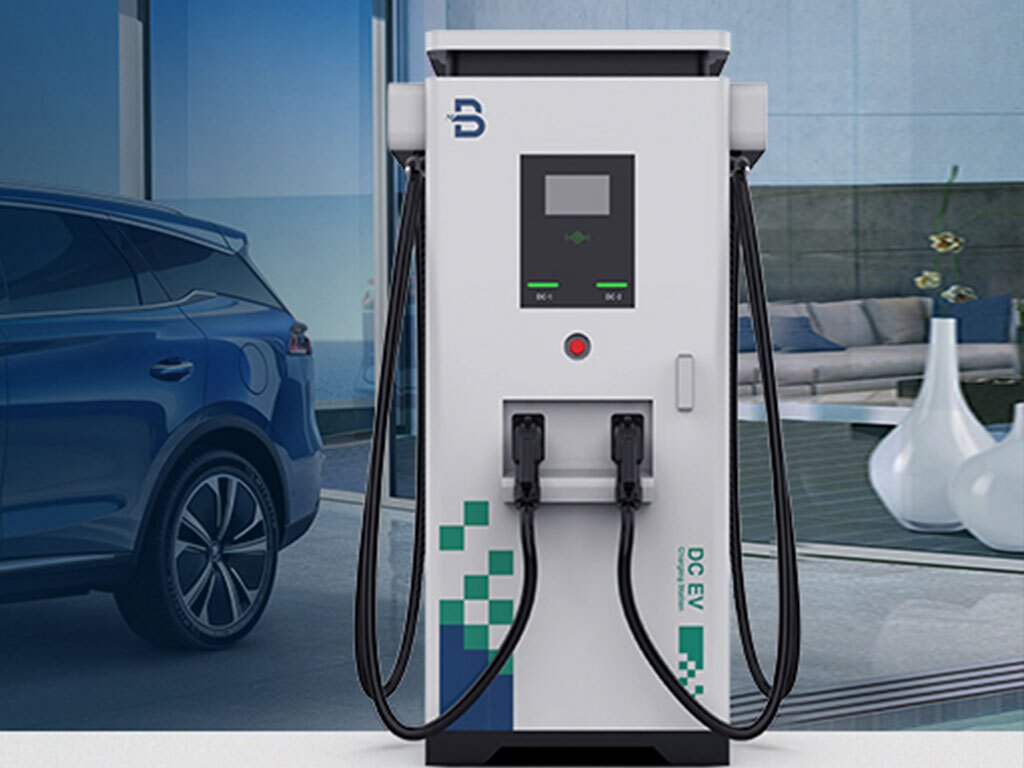
Also, user interface options like big, high-definition touchscreens contribute to the price (typically an extra $2,000 to $5,000) but provide a second source of revenue in programmatic digital advertising. This function is available on Beny’s 2-Guns DC EV Charging Advertising Station. Hardware components such as payment integration systems (RFID readers, credit card terminals) are also required but they are incremental to the base price.
The most common mistake that investors make is to only budget on the hardware and underestimate the soft costs of installation. Infrastructure and installation costs can in most projects be as much as the hardware itself, which is a significant part of the total sunk costs.
Level 3 chargers are a heavy burden to the local electrical grid. One 150kW charger is equivalent to a big supermarket. This means that the installation locations need a lot of electrical upgrades.
Civil engineering and skilled labor costs are involved in the physical change of the site.

After deploying the capital, the economic viability of the station is determined by the management of Operating Expenses (OpEX).
This is arguably the most important variable in the profit equation. Commercial chargers electricity bills consist of two components:
Since Level 3 chargers are capable of drawing huge power in real time, they can cause astronomical demand charges. A station with minimal utilization but a single session at 150kW may pay a demand charge of thousands of dollars, and the effective cost per kWh would be prohibitive. This would need battery energy storage systems (BESS) or intelligent load management software.
The hardware needs to be connected to a Charging Point Operator (CPO) network through OCPP (Open Charge Point Protocol) to operate a public charger. These network charges include payment processing, remote monitoring, and visibility of the app. The average price is between 300 and 800 dollars per port per year. Although this makes the station visible to the drivers, it is a fixed cost that is incurred irrespective of the revenue.
Thermal stress and wear are experienced in industrial power electronics. Cooling fans break down, filters get clogged and screens may be broken. Although the initial years are usually under warranty, the out of warranty repairs of DC chargers are specialized and costly. To achieve high uptime, a conservative budget model must set aside around 1,500 to 3,000 per unit per year on preventative maintenance and reactive repairs.
| Cost Category | Expense Type | Estimated Cost Range (USD) | Key Cost Drivers |
| Hardware Equipment | One-Time (CapEx) | $30,000 – $175,000+ | Power output (50-350kW), dual-port vs. single, screen features. |
| Electrical Infrastructure | One-Time (CapEx) | $10,000 – $50,000+ | Transformer upgrades (if needed), switchgear, metering. |
| Installation & Civil Work | One-Time (CapEx) | $15,000 – $40,000+ | Trenching, concrete pads, labor rates, distance to power source. |
| Soft Costs (Hidden) | One-Time (CapEx) | $5,000 – $15,000 | Permitting, ADA compliance retrofits, commissioning fees. |
| Total Estimated Upfront | Initial Investment | ~$60,000 – $280,000+ | Varies heavily by site readiness & charger tier. |
| Maintenance & Warranty | Recurring (OpEx) | $1,500 – $3,000 / year | Parts replacement, technician visits, extended warranty. |
| Software & Network | Recurring (OpEx) | $300 – $800 / port / year | CPO network fees, payment processing, 4G data plans. |
| Electricity (Demand Charges) | Recurring (OpEx) | Variable (High) | Dependent on utility peak demand rates ($/kW) and usage. |
Budget overruns are usually caused by information asymmetry. Some of the hidden costs are often not included in the first quotes:
The ROI analysis of Level 3 charging will entail the determination of the intersection of the utilization rates and pricing power with the fixed and variable costs as discussed above.
The first lever of profitability is the Utilization Rate. An idle charger will not bring any revenue but will still incur fixed OpEx (demand charges, software fees).
The break-even point is usually reached sooner in businesses that are able to capitalize on the dwell time (e.g. retail centers where drivers spend money charging) or in fleets where the alternative cost of fuel is more expensive.
Smart capital allocation entails the reduction of Total Cost of Ownership (TCO) without affecting the performance of the assets.
Subsidies are a market correction tool to speed up the implementation of infrastructure. The federal Alternative Fuel Infrastructure Tax Credit is available in the U.S. to cover up to 30 percent of the hardware costs (limited to 100,000 per location). Programs at the state level, like the CALeVIP, and utility-side make-ready programs (which pay the cost of transformers and grid connections) can offset half to two-thirds of the initial investment, radically changing the ROI profile.
EV chargers supply chain is usually characterized by numerous distribution layers with a markup of a margin. One of the strategic ways of reducing costs is to buy hardware directly with Original Equipment Manufacturers (OEMs) or source factories. The investors can usually acquire hardware at 15-20% unit prices lower by circumventing regional distributors. This involves collaborating with manufacturers that have strong logistics but enables a more effective capital allocation.
A significant cost driver is installation complexity. Conventional DC chargers typically need external sub-panels, independent residual current devices (RCDs), and complicated breaker systems. Advanced manufacturers, like BENY, incorporate these protection mechanisms into the architecture of the charger. The over-current, over-voltage and leakage protections are internalized, thereby minimizing the use of external componenty. This makes the electrical single-line diagram easier, the number of labor hours needed to install it is less, and the cost of the project material is lower.
During the operation stage, the cost of downtime is two times: the lost revenue and the cost of repair. This risk is addressed by modular power architecture. In a non-modular charger, the failure of a component usually causes the whole unit to stop functioning. In a modular design, power is supplied through parallel power modules (e.g. four 30kW modules to supply 120kW). In case of failure of one of the modules, the charger will still run at a lower power (90kW). This redundancy provides continuity of revenue and enables hot-swapping repairs, which are less costly and quicker than complete unit replacement.
Partnering with BENY directly addresses the two largest financial barriers in Level 3 deployment: prohibitive grid infrastructure upgrades and volatile operational costs. BENY’s portfolio ranges from standard DCFC units (20kW–600kW) to our flagship innovation: the Battery Integrated EV Charger.
This system redefines the cost equation by combining a 42.5kWh storage unit with high-speed 60kW or 80kW output. For sites with limited power capacity, this allows you to deploy fast charging without the massive Capital Expenditure (CapEx) of transformer upgrades. The system effectively “boosts” a low-power grid connection (e.g., 30kW) to deliver high-speed performance, eliminating the need for costly grid expansion.
Operationally, BENY maximizes profitability through intelligent “peak shaving.” The system stores energy during low-cost off-peak hours and discharges during high-demand periods. This shields operators from astronomical demand charges—the primary killer of ROI—while stabilizing the local grid load. By choosing BENY, investors are not merely purchasing hardware; they are securing a strategic asset engineered to lower Total Cost of Ownership (TCO) and accelerate the break-even timeline through integrated storage technology.
Level 3 infrastructure is most rational to invest in entities where time-efficiency is associated with value and high operational cadence is needed. In contrast to Level 2 chargers that are used in long-term parking, Level 3 is a high-turnover asset:
Installation of Level 3 charging stations is a significant financial investment and the overall costs of the project often surpass 100,000 dollars per unit including infrastructure. Nevertheless, considering this as a cost center alone is not taking into account the overall economic trend. The lack of fast charging infrastructure as EV adoption grows presents a market in energy as a seller.
The investment case of Level 3 charging is convincing by performing a strict analysis of hardware selection, controlling the installation soft costs, and maximizing OpEx by controlling demand charges and using reliable technology. It is a type of asset that does not only provide a payback on capital in terms of direct revenue, but also strategic value in terms of future-proofing of the commercial operations. To the wise investor, it is not whether it is expensive or not, but whether the capital is used effectively to realize the long-term value of the electrified mobility transition.