The installation of commercial electric vehicle (EV) charging infrastructure is not a hypothetical project anymore; it has become a strategic necessity of future-proofing commercial buildings, serving staff, and finding a new tier of customers. This guide is designed as a procedural, granular guide to business owners, property managers and fleet operators. It takes one through the entire life cycle of a commercial EV charging station installation, starting with the initial economic evaluation and location planning, through the intricacies of hardware selection, the installation process, and the commissioning of a profitable charging station.
Why It is the Right Time to Invest in Commercial EV Charging
A combination of strong market, regulatory and consumer forces drives the decision to invest in commercial EV charging. The world is moving towards electric mobility, and the growing demand for electric vehicles and rising EV ownership are growing exponentially. This emerging need introduces a direct and increasing need for convenient, dependable charging stations, including public charging stations, beyond the home environment.
This is a unique first-mover advantage to businesses. EV charging properties are distinguished in a competitive market, which serves as a physical facility that increases property value and draws high-value tenants and customers. In the case of workplaces, it is an essential employee attraction and retention tool, which can meet the needs of a modern, environmentally-conscious workforce.
Moreover, the government and regulatory authorities are also encouraging this shift. The growth of ESG (Environmental, Social, and Governance) requirements puts a strain on companies to show actual sustainability goals. One of the most visible and effective ways of attaining these objectives and reducing a property’s carbon footprint is building out EV infrastructure. At the same time, a strong financial incentive ecosystem of tax credits, available rebates, etc., has been issued to de-risk the initial capital outlay, and the economic case has never been stronger. Delay is to run the risk of obsolescence; acting now is to establish a base stake in the new automotive economy.

Step 1 to Success: Project Planning & Site Assessment
The success of an installation is entirely dependent on careful pre-planning. This first step goes beyond the abstract and deals with the concrete, physical and financial facts of your property. The most frequent antecedent to budget overruns, operational failures, and non-compliance with local regulations is rushing this stage.
Define Your Business Goal: Charging for Employees, Customers, Tenants, or Your Fleet?
The main goal of the chargers will determine all the other decisions, including the hardware selection and the pricing schemes. These are not mutually exclusive but have to be prioritized.
- In the case of Employees (Workplace Charging): The objective is retention and amenity. Charging is usually prolonged (6-8 hours). This requires Level 2 chargers, which are usually controlled through access control (RFID cards) to distinguish between employee and guest usage.
- To Customers (Retail/Hospitality): The objective is to attract and spend more time. A retail store or shopping center may be interested in DC Fast Charging to provide a top-up, whereas a hotel would choose Level 2 to serve overnight visitors.
- In the case of Tenants (Multi-Unit Dwellings): It is aimed at retaining tenants and attracting new tenants, which is why higher lease rates are justified. This will need a special Level 2 solution of assigned parking, and integrated software for precise energy billing back to each resident.
- For Your Fleet (Depot Charging): This is an operational objective that aims at reducing downtime. It requires a strong, dependable and in many cases powerful solution (Level 2 or DC fast chargers) combined with fleet management software to make sure that vehicles are charged and prepared to work.
The Site Survey: Electrical Capacity, Parking Layout, and ADA Compliance
The site survey is a technical survey of the feasibility of your property. Electrical capacity is the most significant factor. Your main electrical panel and electrical service should be evaluated by a qualified engineer. Is there enough headroom to accommodate several high-draw chargers? Otherwise, an expensive service upgrade, which may involve a new transformer, will be necessary. This is the biggest variable in your total project cost.
The layout of your parking lots determines the location of chargers, trenching paths (expense of running conduit), and visibility. The placement of the chargers must be in a convenient position that does not interfere with traffic.
Lastly, compliance with the ADA (Americans with Disabilities Act) is a legal mandate that cannot be compromised. You have to install convenient charging points, and this entails certain conditions regarding the size of parking space, the slope of the ground, the clear ground space, and the reach height of the charger and its charging port or connector. Noncompliance may lead to severe legal consequences.
Level 2 vs. DC Fast Charging: Choosing the Right Commercial Charger
Although there is Level 1 (L1) charging, it uses a standard 120-volt wall socket and is practically useless in any serious commercial use because of its very slow rate. The professional option involves choosing the right type of charger: Level 2 or DC Fast Charging (DCFC).
- Level 2 (L2) Charging: This is the commercial standard. L2 chargers are 208-240 volts and offer 12-80 miles of range per hour of charge. They are best suited to long-dwell places where vehicles will be parked over a number of hours including offices, hotels, apartments, and long-visit retail. It is not as complex to install and the hardware is cheaper than DCFC.
- DC Fast Charging (DCFC): Sometimes colloquially known as Level 3 Charging, is a direct current (DC) power supply that goes directly to the battery of the vehicle, bypassing the onboard charger of the car. They are very quick with a range of 60-100 miles within 20 minutes. These DC fast charging stations are the right option in high-turnover places such as public fueling stations, retail corridors, and fleet depots, where the main goal is speed. The trade-off is a far greater cost of hardware and a far more complicated installation, which may need 480-volt, 3-phase power and utility coordination.
Commercial Scenario & Hardware Matching Matrix
To simplify your decision and connect your facility’s needs with the exact equipment required, use the following interactive framework:
| Business Scenario |
Primary Goal |
Recommended Hardware Strategy |
Estimated Dwell Time |
| Workplaces & Offices |
Employee retention, predictable daily charging |
Commercial Level 2 EV Chargers |
6 – 8 Hours |
| Retail & Hospitality |
Attract high-value customers, extend dwell time |
Smart AC Chargers or low-power DC |
2 – 4 Hours |
| Fleet Depots & Gas Stations |
Rapid turnaround, asset utilization |
DC Fast Charging Stations |
20 – 60 Minutes |
Understanding the Full Cost: From Initial Investment to Long-Term OPEX
A detailed budget should be able to differentiate between the one-time Capital Expenditure (CapEx) and the recurrent Operational Expenditure (OpEx).
Capital Expenditure (CapEx) comprises:
- Hardware: The chargers themselves (L2 or DCFC).
- Installation: The labor, trenching (to run conduit underground), concrete work (for pad), new electrical panels, and wiring. This cost may sometimes be higher than the hardware cost, particularly when a lot of site work or electrical upgrades are required.
- Allowing Fees: The administrative fees that you pay to your local municipality.
Operation Expenditure (OpEx) is the cost of ownership in the long run:
- Software & Networking Fees: Smart chargers need a network (such as ChargePoint, EVConnect, or others) to accept payments, control access, and track status. This is usually a monthly or yearly subscription charge per charger.
- Maintenance: A maintenance plan to guarantee uptime and repair.
- Electricity (The Critical Variable): This is the most important and unstable OpEx element. The utility of commercial properties usually imposes a “Demand Charge”. Demand charge is a penalty charge that is calculated on your maximum peak of electricity consumption during a particular billing period, irrespective of the overall consumption. When several EVs start charging at the same time during an afternoon peak, you might cause a huge demand charge, which would blow out your utility bill by thousands. This is a risk that should be handled professionally. To avoid unexpected expenses, read our 2025 breakdown of How Much Does a Commercial EV Charging Station Cost? 2025 Guide.
The “Iceberg” of Commercial EV Installation Costs
To truly understand the financial scope, imagine an iceberg: the hardware and basic installation are visible above the surface, while the deep, expensive infrastructure upgrades lurk below.
Let’s look at a realistic, hypothetical BOM (Bill of Materials) scenario for a retail center:
- The Scenario: Installing four (4) Level 2 chargers, located 50 feet away from the main electrical panel across an asphalt parking lot.
- Hardware (Approx. 30% of total cost): The charging pedestals and cable management systems.
- Trenching & Infrastructure (Approx. 40% of total cost): Excavating the asphalt, laying conduit, pouring concrete pads, and repaving. (This is often the hidden budget killer).
- Permitting, Upgrades & Commissioning (Approx. 30% of total cost): Electrician labor, municipal permits, and activating the network software.
Maximizing Your ROI: Incentives and Profit Models
Profit is realized in two ways: cost reduction (saving) and revenue (earning).
First, you have to vigorously seek cost reduction by incentives. These programs are aimed at absorbing the initial CapEx.
- Federal Incentives: The Alternative Fuel Infrastructure Tax Credit (30C) is a substantial credit in the United States for equipment and installation costs.
- State & Local Rebates: Hardware and installation rebates are provided by many states (such as California, New York, and Colorado) and individual municipalities as large cash-back rebates.
- Utility Programs: Your local electric utility is your best prospective partner. They can offer the biggest rebates, since charging stations allow them to control grid load and encourage electrification.
These rewards are time-bound and their application procedures are complicated; hard work in this case is a great dividend.
Second, the way you make the station a profit center instead of a cost center is through revenue generation.
- Pricing Models: Smart charging software enables you to charge a custom price. You can charge on a kilowatt-hour (kWh) basis, on an hour-connected basis, or on a session charge.
- Access Tiers: You are able to make hybrid models. As an example, the employees can be charged free (as a facility) but charged at a high market rate to the general population. Visitors can pay full price, whereas tenants can receive a discounted rate. This will enable you to make the charger work in line with your core business objectives.
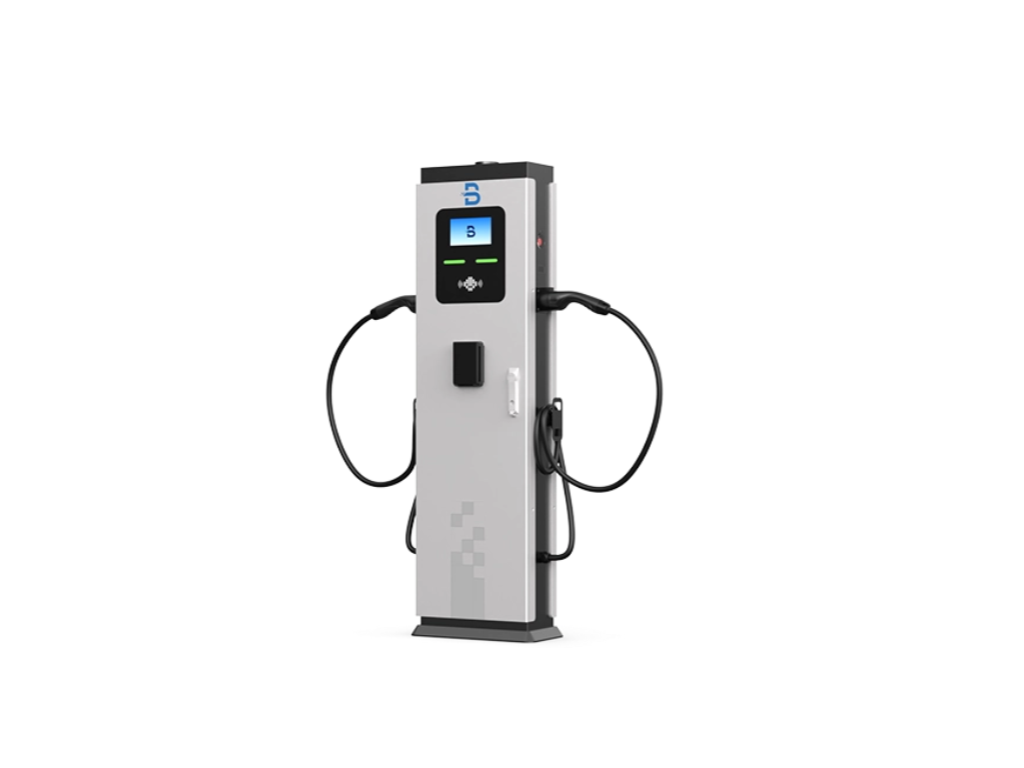
- Advertising & Upsell Revenue: Certain high-tech commercial EV charging stations have digital advertising display screens (such as Beny’s 2
Guns
DC EV
Charging Advertising
Station). These generate a whole new source of income, and you can make more advertising money on your business, either by advertising your own services or selling screen time to third-party advertisers.

The 7-Step Installation Framework: From Design to Activation
The so-called ”turnkey” approach is the involvement of a competent partner to handle the physical installation process, including design and permitting, to the final activation. It is one of the suggested methods to prevent coordination failures on-site so that you (the business owner) can concentrate on the strategic objectives of your charging program.
Steps 1-2: Final Design and Navigating the Permitting Process
After choosing your strategic plan and hardware (as in the case of BENY), the project enters the formal design and permitting stage. This stage involves elaborate engineering schematics and load analysis that plots the whole electrical design. These are plans based on the technical specifications of your selected hardware and are submitted to be approval:
- The Local Authority Having Jurisdiction (AHJ): This is the building department of your city or county that will look at the plans to ensure they are safe and meet the code requirements (electrical, zoning, and ADA).
- The Electric Utility: The utility should give the plan a green light to make sure that it does not adversely affect the grid and to plan any required upgrades of the service.
This ”paperwork” stage is usually the most protracted stage of the project, and it may take weeks or months.
Steps 3-4: Site Work, Trenching, and Electrical System Upgrades
The physical site work commences with approved permits. It is the most disruptive stage. It includes trenching (excavating to install electrical conduit), pouring concrete pads on which the chargers will be placed, and making the required electrical upgrades.
Engineering Precision: Before any trenching equipment breaks ground, professional installation teams will utilize Ground Penetrating Radar (GPR) to meticulously map the subsurface. This critical step ensures that no existing underground water, gas, or telecommunications lines are severed during excavation. Furthermore, all electrical panel upgrades, wiring, and conduit runs must strictly adhere to rigorous compliance standards, such as the National Electrical Code (NEC) in the US, ensuring the infrastructure can safely handle continuous, heavy electrical loads over decades.
The upgrades needed will depend on the current capacity of your building and, most importantly, the power needs of your new chargers (e.g., DCFC units that need 480-volt, 3-phase power).
Steps 5-7: Hardware Deployment, Network Commissioning, and Final Inspection
This is the final stage where your technology is brought online.
- Hardware Deployment: The chargers are physically mounted and connected to the new electrical conduit.
- Network Commissioning: This is the critical software step. It involves connecting the charger’s internal systems (via cellular or Ethernet) to your chosen software network. This activation unlocks the smart features of the hardware—such as the Dynamic Load Balancing (DLB) and payment processing—that you selected during the planning phase.
- Final Inspection: Finally, the AHJ (city inspector) returns for a final inspection. They will verify that the installation matches the approved plans and that the hardware is installed according to its safety certifications (like UL or CE). Upon passing, your station is officially cleared for operation. To evaluate your total investment, please explore the How Much Does a Commercial EV Charging Station Cost? 2025 Guide.
Why a Successful Installation Begins with the Right Hardware
A lot of property owners are only concerned with the cost of installation, treating the charger itself as a commodity. This is an immense financial mistake. The intelligence and quality of the hardware you choose determine the long-term success, profitability, and reliability of your station. The success of an installation is determined by its life of operation and not its initial day.
High-quality commercial hardware has three pillars:
-
- Smart Load Management: This is a direct solution to the issue of “Demand Charge”. Developed chargers, like those of BENY, incorporate Dynamic Load Balancing (DLB). DLB technology is used to monitor the total electrical load of the building in real-time. It then smartly throttles and allocates power to the EV chargers, so that they do not all go beyond the preset capacity of the building. This single feature is the difference between a profitable station and one that causes punitive, unmanageable electricity bills.
- The Real ROI of DLB: The traditional, brute-force solution to an undersized electrical panel is a physical Transformer Upgrade. This infrastructure overhaul can easily cost tens of thousands of dollars and trigger months of utility delays. DLB provides a highly advanced “zero-upgrade” alternative. By utilizing intelligent software to instantly redistribute power, facilities can entirely avoid this exorbitant capital expense (CapEx) while safely maximizing their existing grid capacity.
If you want to analyze expenses, please check out our blog on How Much Does a Commercial EV Charging Station Cost? 2025 Guide.
- Strong Reliability and Certification: A commercial charger is not a residential unit. It is left to be used by people, to withstand the weather and to be vandalized. A down charger is not only a nuisance, but a loss of revenue and a dent in the reputation of your property. It is essential to select hardware from established manufacturers like BENY that is built for commercial-grade durability and holds rigorous international safety certifications (such as CE, UL, and TUV).
- Future-Proofing with Open Standards (OCPP): It is common practice among many networking providers to attempt to “lock you in”, meaning that you can only use their software with their hardware. When you are not satisfied with their charges or service, you can only remedy the situation by tearing out the whole charger and installing a new one. The answer is to insist on hardware that is OCPP (Open Charge Point Protocol) compliant. This is an open standard that BENY chargers are fully compatible with and ensures that your hardware can be used with any OCPP-compliant software network. This provides the owner with the liberty to switch software providers whenever he/she wish, safeguarding his/her investment in the long run.

How to Vet and Choose a Qualified Commercial EV Charger Installer (A Checklist)
Your choice of installer is as critical as your choice of hardware. A general electrician is not a commercial EV installation specialist. Use this checklist to vet potential partners:
| Vetting Criterion |
Key Questions & Verification (What to Ask) |
| Licensing & Insurance |
Are they a licensed C-10 (in California) or equivalent electrical contractor? Ask for proof of appropriate liability insurance to protect your property. |
| Verifiable Commercial Experience |
Ask for a portfolio. Have they installed projects of a similar scale? Can they provide specific references from other property or fleet managers? |
| Turnkey Capability |
Do they handle the entire installation phase—design, permitting, utility coordination, and commissioning? This is crucial to ensure you don’t have to act as the general contractor. |
| Knowledge of Local Codes & Utility |
Do they have existing, positive relationships with your specific municipality and utility company? This experience can dramatically expedite the complex permitting process. |
| Hardware Expertise & Neutrality |
Do they push one exclusive brand (a potential red flag), or do they recommend high-quality, open-protocol hardware based on your specific goals? A quality installer will be familiar with and recommend expert-vetted hardware that prioritizes long-term operational health (DLB, OCPP) over simple installation. |
Conclusion: Your Next Steps to Launching Your Commercial Charging Station
A commercial EV charging station is a strategic project with high value, rather than a mere convenience. It makes your property a point on the new mobility grid. Success is not achieved in the installation itself as explained in this guide, but in a holistic process that goes beyond careful planning to smart hardware choice.
With a clear definition of your goals, a clear understanding of your actual costs (including OpEX) and a selection of hardware that proactively reduces those costs (such as chargers with Dynamic Load Balancing), you can implement a project that transitions to profit in a planned manner.
© 2025 Commercial EV Charging Installation Guide – Professional EV Charging Solutions